GABA, melatonin and L-theanine – how do they differ?
04 August, 2026

You are standing in front of a shelf of supplements or browsing the range of an online shop and you see three extremely popular names: GABA, melatonin, L-theanine. The descriptions on the packages sound deceptively similar. Every manufacturer promises calming, a reduction of tension and deep, regenerating rest. Although the marketing slogans suggest identical action, from the biochemical side these are substances with completely different mechanisms and points of action in our body.
Every conscious consumer knows this dilemma. How are you supposed to know which of these ingredients is right for your individual needs, when all of them are advertised as a recipe for “calm”? In order to make the right decision and not waste money on products that do not match the source of your problem, you have to get to know the biological facts. The answer to the question of how GABA differs from melatonin and L-theanine is hidden in the way these molecules communicate with your nervous system.
The brain under pressure works a little like a big city at rush hour. In order to prevent paralysis and chaos, various control systems are needed. In this analogy GABA acts like a red light that smoothly stops excessive traffic. Melatonin is the clock on the town hall tower, which precisely announces to all the inhabitants the end of the day and the time for rest. L-theanine, in turn, resembles a calm passenger in a crowded, noisy tram – this passenger is able to maintain full attentiveness and clarity of thinking despite the din all around.
What is GABA and how does it work in the body?
In order to understand precisely how this substance works, we first have to explain the concept of a neurotransmitter. A neurotransmitter is a special chemical molecule which serves to transmit signals and information between individual nerve cells (neurons) in the brain. Neurotransmitters are divided into two main groups: excitatory ones (which stimulate the nervous system to act, such as glutamate) and inhibitory ones.
Answering the question of what GABA (gamma-aminobutyric acid) is, it should be pointed out that it is the main inhibitory neurotransmitter in the whole human central nervous system. Its fundamental biological role is literally to “cool down” excessive activity of the neurons. When the level of stress rises and thoughts start to race, GABA acts as a biological safety brake. Supplementation containing GABA for calming and GABA for sleep is intended to support the body in entering a state of deep physical and mental relaxation.
It is worth keeping scientific honesty, however, and mentioning an important issue which is the subject of constant discussion among researchers. Gamma-aminobutyric acid taken in the classic oral form shows a limited ability to cross the blood-brain barrier directly (that is, the special, tight barrier protecting the brain against foreign substances). Scientific studies indicate, however, that GABA supplementation may exert a positive influence indirectly – through its effect on receptors located in the digestive system, which is extremely densely innervated and connected directly with the brain by means of the so-called gut-brain axis.
What is melatonin and what role does it play?
Unlike GABA, melatonin is not a neurotransmitter but a hormone. It is naturally produced in our body by a small endocrine gland – the pineal gland. The secretion of melatonin is closely connected with lighting conditions; its production rises sharply in response to falling dusk, and it is blocked by sunlight and by the omnipresent blue light emitted by the screens of smartphones and televisions.
When analysing how melatonin works, we have to refute a widespread myth: its main task is not at all to directly induce an immediate state of sleepiness or to “switch off” consciousness. Melatonin is an important regulator which synchronises our internal biological clock and controls the circadian rhythm of sleep and wakefulness. It informs every cell of the body that night has come and that it is time for regeneration. For this reason melatonin will not work as a universal calming agent during a stressful day. It is, however, highly effective in situations where our natural circadian rhythm has become disrupted – for example in shift work, in insomnia in older people, or in jet lag syndrome caused by a sudden change of time zones during air travel.
What is L-theanine and where does it come from?
The third of the compounds discussed is L-theanine – a unique non-protein amino acid whose richest natural source is the leaves of green tea (Camellia sinensis). It is precisely the presence of L-theanine that makes an infusion of green tea, despite its content of stimulating caffeine, show a toning and relaxing effect at the same time.
The way L-theanine works sets it apart from other calming substances. Unlike the oral form of GABA, L-theanine crosses the blood-brain barrier without the slightest problem and extremely efficiently. After reaching the central nervous system it begins to gently modulate the activity of brain waves, stimulating the emission of Alpha waves. Alpha waves are characteristic of a state of deep but fully conscious relaxation – the kind that accompanies us, for example, during meditation. Thanks to this, using L-theanine for stress brings an effect described as “calm focus”. It helps to quieten anxiety and racing thoughts while at the same time not causing a feeling of dullness, apathy or incapacitating sleepiness.
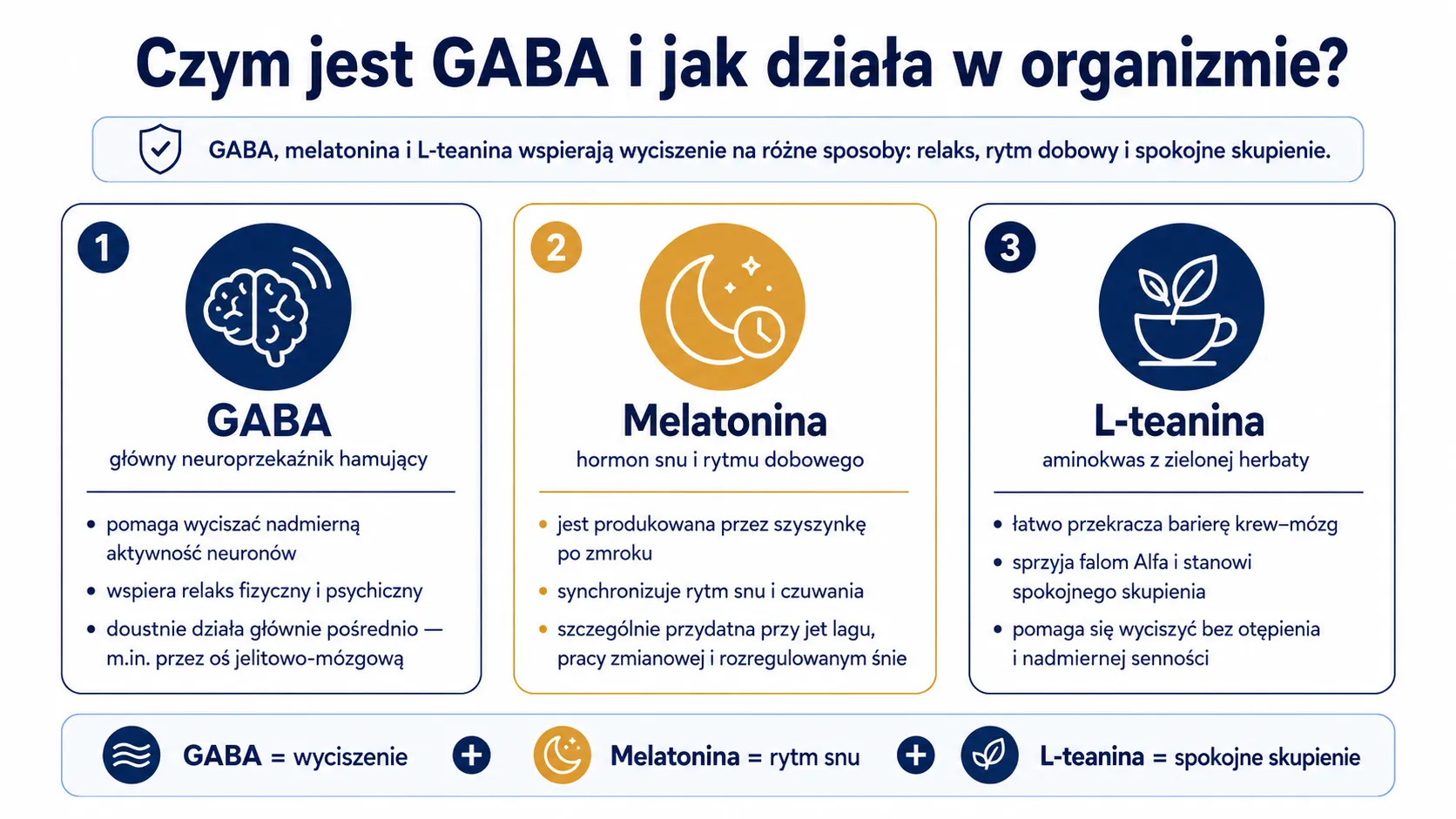
GABA, melatonin and L-theanine – important differences in the mechanism of action
By placing these three substances side by side, we can clearly see the structural differences between GABA and L-theanine as well as melatonin:
- GABA. It acts directly at the source of nervous arousal as a biochemical brake (mainly through the gut-brain axis when administered orally), reducing overall physical tension of the muscles and reducing anxiety.
- Melatonin. It acts as a hormonal keeper of time; it does not directly calm agitated emotions, but precisely sets the biological clock to the night phase.
- L-theanine. It acts as an intelligent modulator of mood; it freely penetrates into the brain, raises the level of natural gamma-aminobutyric acid and of dopamine, quietening stress while at the same time preserving full sharpness of mind and concentration.
When to choose GABA, when melatonin and when L-theanine?
The choice of the right supplement depends on precisely diagnosing the nature of your difficulties. Here is a practical decision guide:
- Choose melatonin if your main problem is a disrupted circadian rhythm. If you go to bed at irregular times, work at night, suffer from jet lag or, despite being tired, cannot fall asleep before 2:00 at night, this hormone will help you restore the natural harmony of time.
- Choose L-theanine if you need composure and clarity of mind during the day. This is the ideal solution if you are facing a stressful professional challenge, an exam or a presentation and want to reduce anxiety but cannot afford a drop in concentration or sleepiness.
- Choose GABA (or a combination of L-theanine with minerals) if in the evening you feel physical tension in your body, your muscles are tight and the flood of stressful thoughts from the whole day makes it impossible for you to move freely into a state of rest.
When considering the dilemma of L-theanine or melatonin in the context of night-time problems, remember that L-theanine will help you put out the emotional fire after a hard day, while melatonin will give your cells the signal that it is time for sleep if your biological clock has lost its way in the darkness.
Can GABA, melatonin and L-theanine be combined?
The good news is that these substances do not enter into negative interactions with one another, and their mechanisms of action can complement each other very effectively. In advanced formulas these ingredients are very often combined in order to obtain a synergy effect. For example, taking L-theanine in the evening can help to quieten an agitated nervous system, thereby making it easier for melatonin to fulfil its hormonal role optimally.
It should be remembered, however, that when combining any products it is always worth being cautious and not exceeding the doses recommended by the manufacturer, and in the case of chronic, deep problems with insomnia and with anxiety states – consulting a medical specialist without fail.
How to choose a good-quality supplement with GABA, melatonin or L-theanine?
You have to be aware that no calming ingredient, not even the most advanced one, will work fully optimally if your nervous system is biochemically depleted. For the proper synthesis of its own neurotransmitters (including GABA and serotonin), the brain absolutely needs a solid base in the form of magnesium ions and a complete set of B vitamins. Moreover, chronic mental tension generates powerful oxidative stress in the body, which destroys nerve cells from within.
That is why the foundation of conscious supplementation should be to provide the body with a stable nutritional base. It is worth paying attention to modern products with maximum absorbability, such as the Liposomal complex of B vitamins with magnesium and potassium B-Complex-Mg-K™. Thanks to the use of a lipid envelope, these ingredients are protected in the digestive tract and go directly to the cells, taking care of normal nerve conduction. In order to effectively protect the nervous system against the destructive influence of free radicals caused by stress, the ideal complement to your everyday protective shield will be the Liposomal LongLifeLip® supplement protects against free radicals.
If your overriding goal is direct, night-time regulation of the biological clock, look for products created on the basis of innovative carriers that guarantee stable release of the substance. An example of such a solution is the advanced Liposomal MelatinLip™ supplement for sleep. You will find a wide range of safe and tested compositions supporting night-time regeneration directly from the manufacturer in the dedicated categories covering professional sleep supplements and targeted insomnia supplements. People looking for effective calming during a demanding day, in turn, can take a look at the products gathered in the stress supplements section.
By making a choice based on biochemical knowledge rather than on promises from advertisements, you gain the certainty that you are supporting your body in a precise, safe and effective way.
AI GENERATED - the illustrative images in this article were generated using artificial intelligence.
See also
other posts

Trouble falling asleep – the most common causes and ways to sleep better
Sleep does not always come as soon as you switch...
More about our technology

Can magnesium be taken at night?
An intense lifestyle, tense muscles after a whole day and...
More about our technology

Healthy sleep and its importance – what affects sleep?
Contrary to appearances, the term „healthy sleep” is still rarely...
More about our technology