Healthy sleep and its importance – what affects sleep?
Contrary to appearances, the term „healthy sleep” is still rarely used in…
Contrary to appearances, the term „healthy sleep” is still rarely used in what we read, and defined even more rarely. People often talk about insomnia, about difficulties falling asleep, about the right number of hours of sleep. Far less often do we talk about the quality of sleep, and yet it is quality that determines many aspects of our overall health. Health which, in the 21st century, is defined not only as the absence of illness, but as our general condition, our well-being, our everyday efficiency and energy. Why is it worth taking care of healthy sleep and how can it be done? Find out more by reading this article.
Researchers have established that sleep takes up one third of human life and is an indispensable part of it. Each of us, however, has a different need for sleep, which additionally changes with age. In adults it amounts to between 6 and 8 hours a day.
We often do not realise that good sleep is of key importance for health. This was proved in studies on rats that were completely deprived of sleep – all of them died after 2-3 weeks (1). For several years now, researchers from various fields have been investigating the role of healthy sleep in the context of a variety of diseases and disorders. It turns out that both a shortage of sleep and its poor quality contribute to many health problems. Below we present an overview of the potential problems that may be brought on by inadequate sleep quality.

Dimensions of sleep and potential health effects:
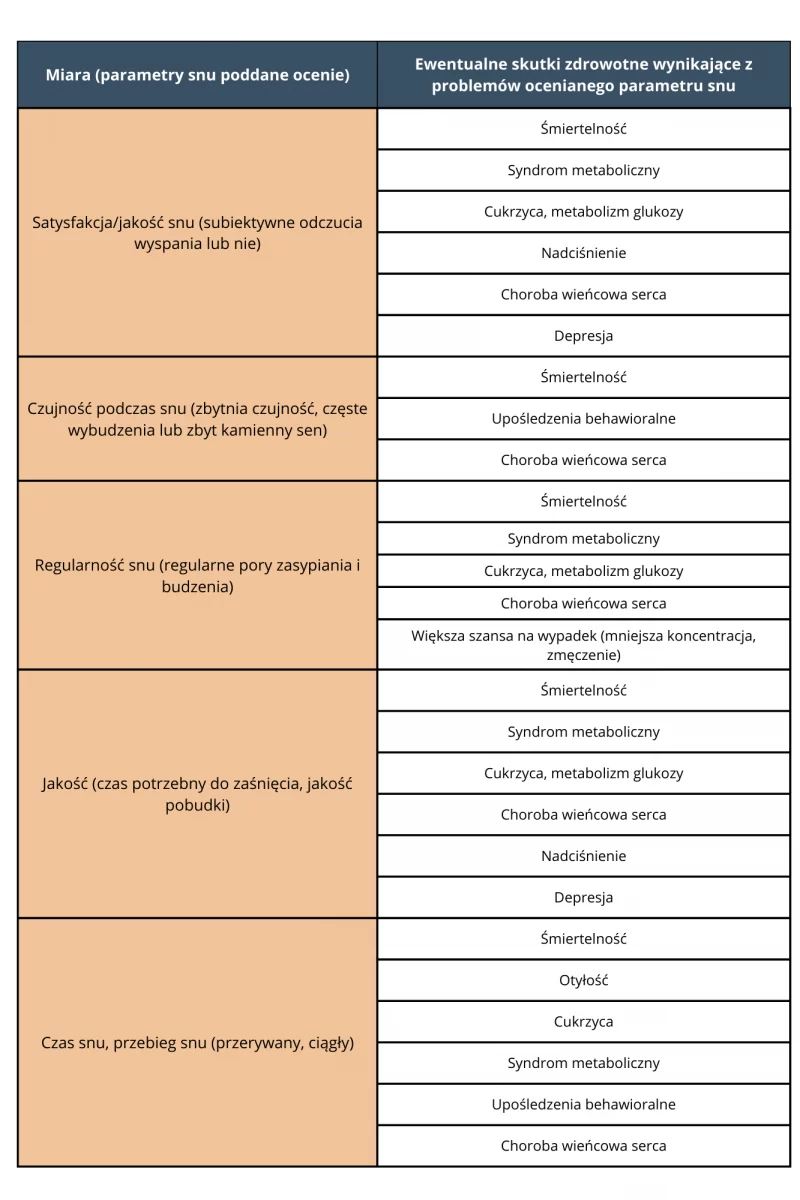
Source of the table: https://bit.ly/3sjTJU6
Did you know that …
Studies show that people who sleep an insufficient number of hours a day suffer from obesity more often. This is connected with our hormonal and metabolic balance. A body short of sleep tries, colloquially speaking, to maintain its efficiency by making up for its energy deficits. Put more simply, if we do not get enough sleep we will be hungrier, but it will also be harder for us to feel full after a meal. A loss of restraint may appear (2). This mechanism concerns not only adults, but also affects more and more children, who, because of the development of technology, sleep for shorter and shorter periods, and their sleep is of ever poorer quality (3).
Both too little and too much sleep is harmful
For many years researchers have been focusing their attention on the analysis of sleep and on the importance of its stages for the body. After falling asleep brain activity decreases; at the beginning “light sleep” appears, which over time passes into “deep sleep”, and then the heart rate, the breathing rate, the arterial blood pressure and muscle tension all decrease. During this time four NREM sleep phases follow one after another. Towards the end of this phase the position of the body often changes and we move on to the 5th phase of sleep. It has been established that the five phases together last 70–120 minutes and constitute one cycle. There are several such cycles during sleep. With each successive one the length of “deep” sleep decreases in favour of the lengthening phase of “light sleep”, that is the REM phase.
What is insomnia?
By definition, insomnia is a subjectively experienced poor quality of sleep which clearly impairs functioning during the day. Insomnia is diagnosed when, apart from a disturbance in the course of sleep (problems falling asleep, difficulties maintaining continuity of sleep, waking up too early), the patient also reports tiredness and a clear deterioration in mental well-being and in social functioning.
When should you reach for sleep supplements?
In situations where sleep problems become serious, it is worth considering sleep supplements. Among them, liposomal GABA, known for its beneficial influence on the nervous system, is gaining more and more popularity. It is also worth paying attention to B group vitamins, which support healthy sleep by regulating brain function and energy metabolism.
There is a lot you can do to regain healthy sleep.
Through small changes in your everyday routine, putting the smartphone away at least 30 minutes before falling asleep, through a balanced diet, to high-quality supplementation. A well-nourished body will regain its balance and get back on the right track more quickly. Every well-slept night will add to your energy and put you in a positive frame of mind for action, and this will affect your hormonal balance and the general condition of your body.
Supplement your everyday diet with good dietary supplements, go for MelatinLip™ Good night. It is good and effective support.
Let us take a look at the ingredients contained in MelatinLip™ Good night.
Gamma-aminobutyric acid (GABA)
An inhibitory neurotransmitter, it is regarded as one of the main neurotransmitters with a positive influence on the process of sleep. Modulation of the GABA receptor is one of the four key mechanisms of action of approved pharmacological therapies for insomnia (the other three mechanisms are melatonin receptor agonism, histamine 1 receptor antagonism and hypocretin/orexin antagonism) (4). Gamma-aminobutyric acid (GABA) is an amino acid present in our bodies – a neurotransmitter in the brain. It reduces the activity of the nervous system and can have a positive influence on calming the mind before sleep and subjectively reduce the stress experienced.
Vitamin B₆
It helps to reduce the feeling of tiredness and fatigue, to maintain normal psychological functions and the normal functioning of the nervous system. It contributes to the maintenance of a normal energy-yielding metabolism, helps in the normal production of red blood cells, helps in the normal functioning of the immune system and contributes to the regulation of hormonal activity. Deficiencies of vitamin B₆ can lead to serious sleep disorders and even to depressive states. The latest research indicates that vitamin B₆ influences the remembering of dreams as well as their quantity and quality (5).
L-theanine
It is a non-protein amino acid, a compound unique to Camellia sinensis tea, which influences the production of alpha waves in the brain, may support thought processes and shows a calming action while at the same time not causing drowsiness (6). It has an action antagonistic to theine, relaxing and calming, with a positive influence on the work of the brain. It shows a beneficial effect on the quality of sleep.
Melatonin
This is a hormone produced at night by the pineal gland; it serves as a hand of the biological clock. With age and with certain illnesses the production of melatonin is reduced or shifted in time. In turn, as has already been mentioned above, disturbances of the circadian rhythm and poor sleep quality can have a negative influence on the cardiovascular system, on metabolism and on cognitive functions, and can cause a general deterioration in the quality of life (7). Melatonin helps in the alleviation of the subjective feelings of jet lag and in the reduction of the time needed to fall asleep. An adequate level of melatonin in our body has a positive influence on the sleep cycle and on the ease of falling asleep. In the human body melatonin is produced by the pineal gland – a small gland located in the third ventricle of the brain. The production of melatonin by the pineal gland is very strongly dependent on the time of day and of the year, and its normal production begins with dusk.
Do not underestimate an area of life that takes up so much of your time. Healthy sleep means a healthy day, and the other way round. To sum up, if you consciously take care to improve the quality of your sleep, you will gain health and energy, you will gain a better life.
References:
- https://www.researchgate.net/publication/51425557_Sleep_Deprivation_of_Rats_The_Hyperphagic_Response_Is_Real
- https://www.ncbi.nlm.nih.gov/pmc/articles/PMC7914492/
- https://www.ncbi.nlm.nih.gov/pmc/articles/PMC6571639/
- https://www.ncbi.nlm.nih.gov/pmc/articles/PMC6057895/
- https://pubmed.ncbi.nlm.nih.gov/29665762/
- https://www.researchgate.net/publication/330829762_GABA_and_l_-theanine_mixture_decreases_sleep_latency_and_improves_NREM_sleep
- https://www.ncbi.nlm.nih.gov/pmc/articles/PMC6057895/
See also
other posts
Trouble falling asleep – the most common causes and ways to sleep better
Sleep does not always come as soon as you switch...
More about our technology

GABA, melatonin and L-theanine – how do they differ?
You are standing in front of a shelf of supplements...
More about our technology
Can magnesium be taken at night?
An intense lifestyle, tense muscles after a whole day and...
More about our technology