Trouble falling asleep – the most common causes and ways to sleep better
14 September, 2026

Sleep does not always come as soon as you switch off the light. Sometimes a more stressful day, a late coffee or a longer time spent on your phone is enough for trouble falling asleep to appear despite clear tiredness. If it happens only occasionally, it does not have to indicate a sleep disorder. It is worth noticing, however, whether a similar situation keeps recurring and whether we really wake up rested in the morning. What matters is not only the number of hours spent in bed, but also the quality of your night's rest.
If you often wonder why you can't fall asleep, it is worth looking at what may be making it harder to rest at night. The cause may be everyday habits, stress, an irregular daily rhythm, stimulants, the conditions in the bedroom, but also health problems. That is why, instead of focusing solely on how to fall asleep as quickly as possible, it is better to look at your whole daily rhythm. Sometimes a few simple changes are enough to create better conditions for the body to rest. If the difficulties persist for a longer time, however, it is worth treating them as a signal that needs more attention.
Trouble falling asleep or insomnia – when do sleep difficulties become a problem?
A single problem with falling asleep does not yet mean insomnia. A worse night may follow a stressful event, a change in your daily schedule, travel, a late workout or long hours in front of a screen. We speak of insomnia when problems with getting to sleep or staying asleep recur regularly and affect your well-being and functioning during the day. Typical symptoms of insomnia may include difficulty falling asleep, frequent waking, waking up too early or feeling unrested despite the time set aside for rest.
It is therefore worth observing not only the evening, but also the rest of the following day. If tiredness, irritability, poorer concentration or a feeling that the night did not bring recovery appear regularly, the sleeping problem is starting to affect everyday functioning. Difficulties that persist for weeks or months are particularly important. In that case, searching on your own for yet another remedy for insomnia may not be enough, because the most important thing is to establish the cause.
Why can't I fall asleep? The most common causes of sleep problems
There is no single set of factors responsible for all sleep problems. For one person stress will play the main role, for another irregular working hours, caffeine drunk in the late afternoon or unsuitable conditions in the bedroom. On top of this there may be health problems, medicines being taken or circadian rhythm disorders. The most common causes of insomnia and periodic trouble falling asleep often overlap, so it is worth looking at several areas at the same time.
Stress, tension and racing thoughts before bed
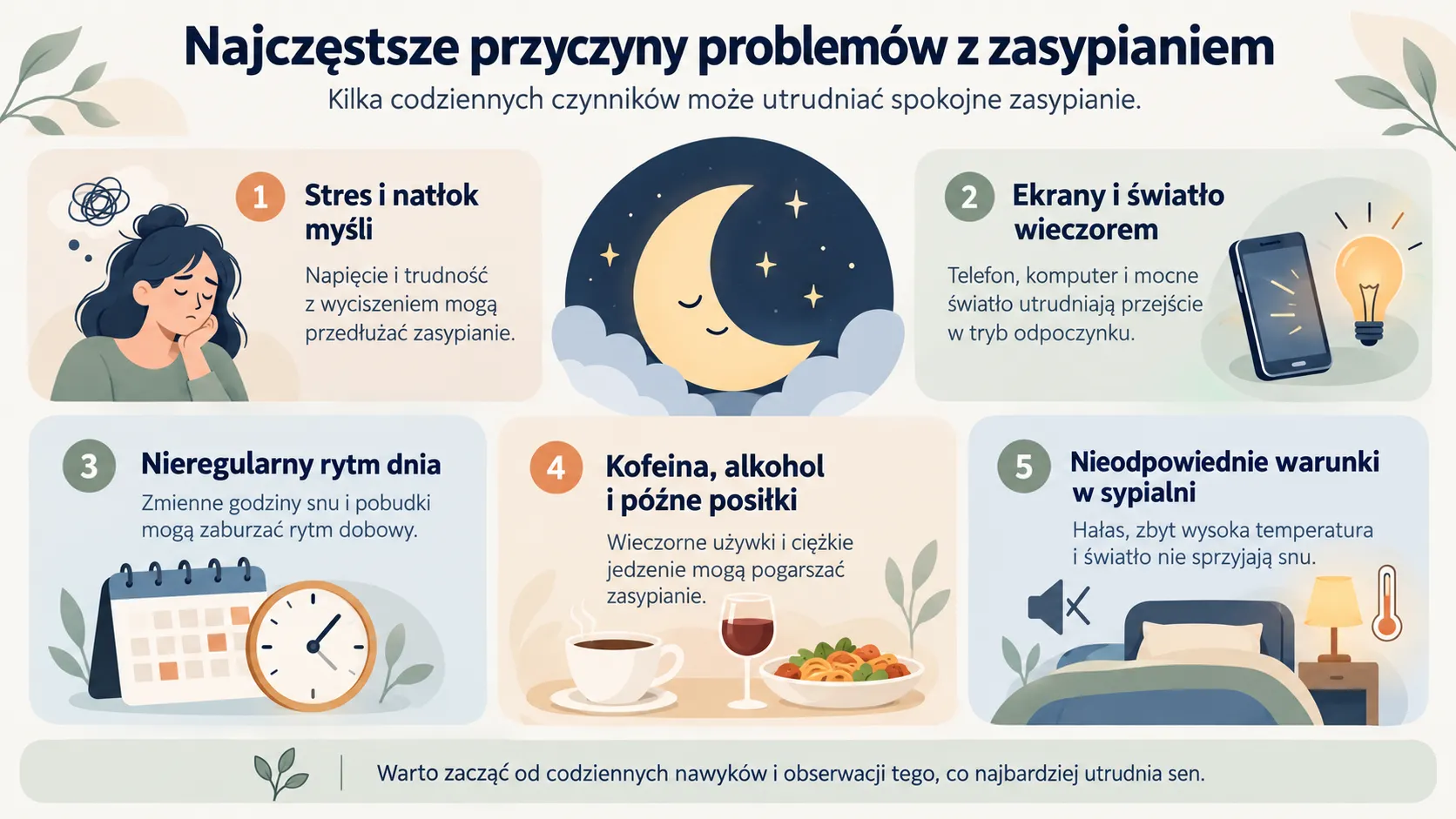
The day may be over, but the mind does not always slow down with it. Thinking about work, duties, conversations or plans for the next day keeps the body in a state of arousal. That is why one of the common answers to the question of what makes it hard to fall asleep is precisely mental tension. The harder we try to force ourselves to sleep, the greater the frustration that may appear.
It can help to introduce a calm transition period between the active part of the day and sleep. This could be reading, a warm shower, calm music, a few minutes of breathing exercises or writing down the things to do the next day. This way you do not have to sort out all your affairs only once your head is on the pillow.
Screens, light and an irregular daily rhythm
Working at the computer until late in the evening, scrolling through social media in bed and bright lighting can make it harder to wind down before sleep. The problem gets worse when the times of falling asleep and getting up differ significantly from day to day. The body works better when it receives relatively regular signals about the times for activity and rest.
If you often find yourself saying “I can't sleep at night”, take a look at what the few hours before going to bed look like. A good first step may be to limit screen use at least for some time before sleep and to dim the lights in the evening. A regular time for getting up, in turn, helps to stabilise the circadian rhythm. Sleep hygiene recommendations often emphasise the importance of regular sleeping hours, a quiet and cool bedroom and limiting the use of electronic devices before bed.
Caffeine, alcohol and late meals
Coffee drunk in the second half of the day can still affect the body in the evening. Sensitivity to caffeine is individual, so it is worth observing after what time it starts to make falling asleep harder. Alcohol, on the other hand, may initially cause drowsiness, but this does not mean that it promotes good-quality rest at night. Large meals eaten just before bed also matter. If difficulties falling asleep appear regularly, it is worth checking whether your dinners are too late and too heavy.
What to do when you can't fall asleep? Everyday ways to sleep better
Wondering what to do to fall asleep? It is best to start with simple things that can be repeated every day. Predictability helps the body. A fixed time for getting up, a calmer pace in the evening and fewer stimuli can, over time, make it easier to switch into rest mode.
When you have trouble falling asleep, try to:
- get up at a similar time in the morning, even after a worse night,
- make sure you are physically active during the day,
- limit caffeine in the later hours,
- dim the lights and put your phone away before bed,
- air the bedroom and make sure it is quiet,
- create a simple evening ritual that you associate with rest.
You do not have to introduce all the changes at once. If you are wondering how to improve the quality of your sleep, choose two or three habits to begin with and stick to them regularly. This makes it easier to judge which actions make a real difference.
Sleep hygiene – which habits help the body prepare for rest?
Good sleep hygiene is above all a set of repeated behaviours that create conditions conducive to rest at night. Regular sleeping hours are important, but so are the temperature, darkness and noise level in the bedroom. It is best to associate the bed mainly with rest, instead of turning it into a place for working, watching series or scrolling through your phone. Healthy sleep recommendations also include regular exercise during the day and avoiding large meals, alcohol and caffeine before bed.
Sleep, however, also depends on the general functioning of the body. Regular eating and meeting your requirements for vitamins and minerals matter, as does an adequate amount of exercise and recovery during the day. In certain situations, sleep supplements can complement your everyday care for your body, but they should not replace work on your habits or the diagnosis of persistent complaints. Similarly, insomnia supplements are not a universal answer to all the reasons for insomnia, because the source of the problem may be quite different.
For one person, sleep difficulties may result mainly from chronic stress, for another from a disrupted circadian rhythm, and for yet another from health problems or the effects of medicines being taken. For this reason, it is worth taking a broader view of sleep and not assuming that every case requires the same approach.
Sleep problems – when is it worth consulting a specialist?
If difficulties appear occasionally and can be linked to stress or a change in your daily rhythm, looking after your everyday habits is usually enough. Consulting a specialist becomes particularly important when the problems persist for a longer time, clearly affect your functioning during the day, or when waking during the night, waking very early or lying awake for a long time occur regularly. The cause may be not only habits, but also other sleep disorders, health complaints, medicines being taken or psychological problems.
Good sleep usually does not depend on a single evening trick. If trouble falling asleep affects you too, start with more exercise during the day, a regular circadian rhythm, fewer stimuli in the evening, calm winding down and the right conditions in the bedroom. If, despite these changes, the difficulties do not go away or increasingly affect your everyday life, it is worth consulting a specialist and looking for their real cause.
See also
other posts

GABA, melatonin and L-theanine – how do they differ?
You are standing in front of a shelf of supplements...
More about our technology

Can magnesium be taken at night?
An intense lifestyle, tense muscles after a whole day and...
More about our technology

Healthy sleep and its importance – what affects sleep?
Contrary to appearances, the term „healthy sleep” is still rarely...
More about our technology