Can magnesium be taken at night?
18 May, 2026

An intense lifestyle, tense muscles after a whole day and difficulty in winding down before sleep – experiences of this kind accompany a growing number of people looking for ways to help the body regenerate. If you are wondering whether magnesium can be taken at night, you are in the right place – the answer to this question depends on several important factors, which we will analyse together in the article below.
Magnesium performs hundreds of functions in the body (from supporting the nervous system, through regulating the work of the muscles, to taking part in energy processes), which is why the time at which it is taken can genuinely influence the perceptible effects of supplementation. Find out which option will work best in your case and learn how to consciously include this mineral in your daily routine.
At what time should magnesium be taken: in the morning or in the evening? It depends on your needs
The choice of the best time for magnesium depends above all on the effects you expect from supplementation – the body uses this element in a variety of processes taking place both during the day and during the night's rest. People who need energy support and better concentration may derive greater benefit from a morning dose, whereas those struggling with muscle tension or with difficulties in winding down often prefer evening supplementation.
It is also worth remembering that products containing magnesium in combination with B group vitamins may have a stimulating effect in some people, so with preparations of this type it is recommended to observe your own reactions and to adjust the time of taking them to your individual needs. The key remains consistency and conscious listening to the signals coming from your own body.
Can magnesium be taken in the evening? Yes – for many people this is the best time
Magnesium supplementation in the evening is an excellent choice for people who lead an intense lifestyle. Magnesium before sleep contributes to the relaxation of tense muscles which have worked under load throughout the whole day, and at the same time it supports the proper functioning of the nervous system responsible for the regulation of states of relaxation.
Healthy sleep and its importance for the body cannot be overestimated, which is why including magnesium in your evening routine may prove to be a simple and at the same time effective step towards better regeneration. If after an intense day you feel a characteristic tension in your shoulders, back or calves, an evening portion of this mineral should bring noticeable relief and make it easier to move into a state of calm that favours falling asleep.
Is magnesium on an empty stomach or after breakfast a good idea? Support for morning energy
Morning supplementation of magnesium on an empty stomach or together with the first meal works particularly well in people who want to improve their concentration in the first half of the day. Magnesium takes part in the processes of producing ATP – the main carrier of energy in the cells – thanks to which its presence in the body from the morning onwards may have a beneficial influence on well-being and on the effectiveness of one's actions.
When wondering when to take magnesium: in the morning or in the evening, take into account your daily rhythm and the moments at which you feel the need for support most strongly. Physically active people often choose a morning dose in order to prepare the muscles for exertion, whereas preparations combining magnesium with a complex of B vitamins may additionally support cognitive functions and reduce the feeling of tiredness during the day.

Does magnesium improve the quality of sleep? The question of falling asleep and of night-time regeneration
Studies indicate that an adequate level of magnesium in the body may contribute to an improvement in the quality of sleep, because this mineral supports the proper work of the nervous system and favours the regulation of the neurotransmitters responsible for relaxation. Magnesium taken regularly to calm down may therefore make it easier to pass from the phase of activity into a state of quietening. Sleep supplements containing this ingredient are enjoying growing popularity, among other things because of their gentle mechanism of action and the possibility of using them over a longer period.
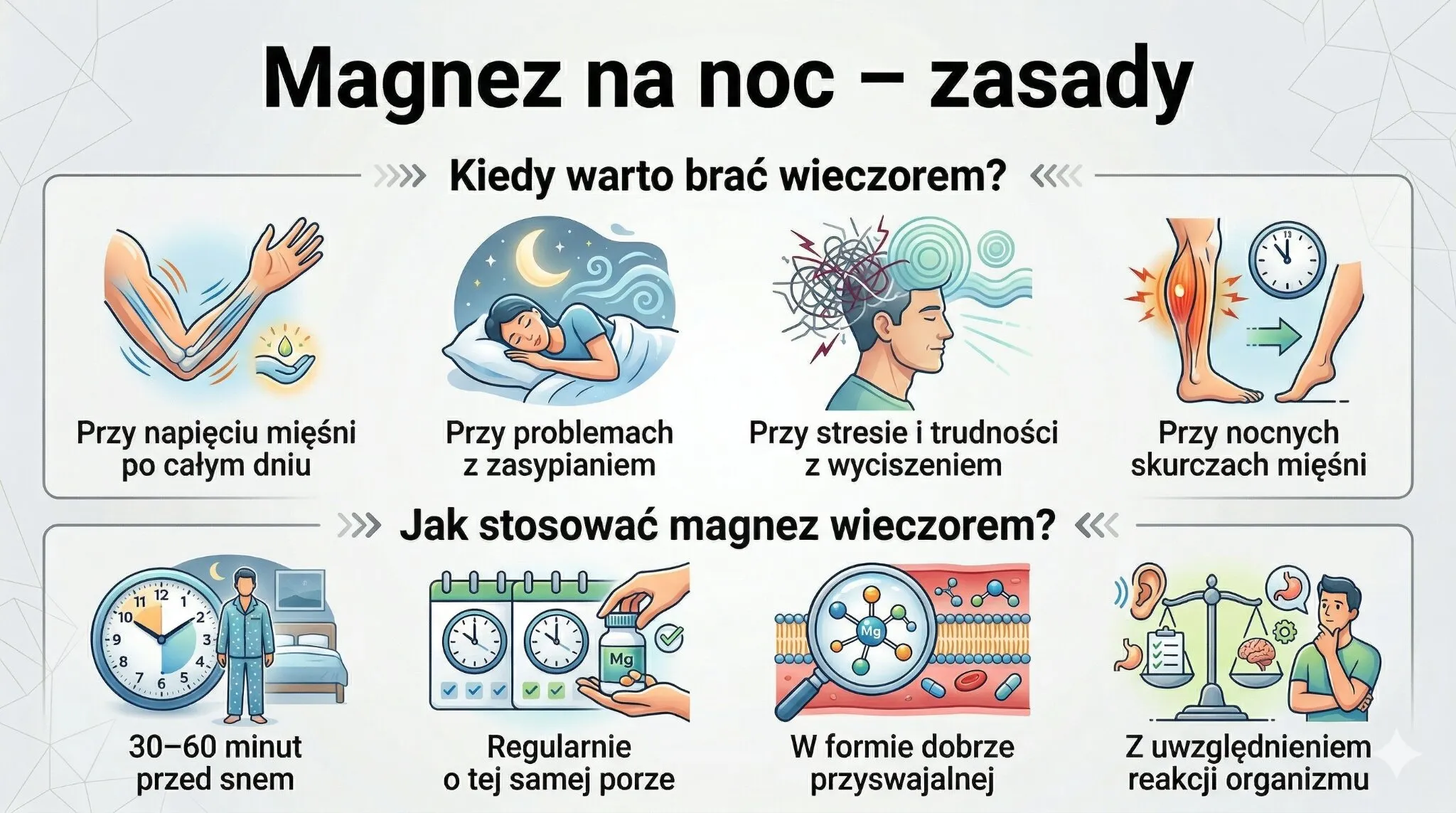
It is worth considering evening supplementation if you notice the following signals in yourself:
- you feel muscle tension particularly in the evening hours or just before falling asleep;
- you have difficulty quietening your thoughts after an intense, stressful day;
- you wake up at night because of cramps in your calves or feet;
- despite being tired, you toss and turn for a long time before falling asleep;
- in the morning you get up with a feeling of not having had enough sleep and with muscle stiffness.
Why is magnesium taurate recommended before sleep? A natural ally of relaxation
Taurine is an amino acid that may support the functioning of the nervous system and contribute to the reduction of excessive arousal; in light of this, magnesium for the night in the form of taurate constitutes an interesting option for people looking for natural support for relaxation. Our B-Complex-Mg-K™ contains precisely magnesium taurate in combination with citrate, thus offering two highly absorbable organic forms in a single product.
An additional advantage is the liposomal technology, which increases the bioavailability of the active ingredients in comparison with traditional tablet forms. Magnesium before sleep in the form of a liposomal gel is absorbed more efficiently, and its action is often felt more quickly than in the case of classic supplements.

B-Complex-Mg-K™ liposomal complex of B vitamins with magnesium and potassium
Is it worth combining magnesium with vitamin B6 at night? Better absorption and support for the nervous system before sleep
Vitamin B6 (pyridoxine) supports the transport of magnesium into the interior of the cells – as a result, the combination of these two ingredients increases the effectiveness of supplementation and brings better results than using the mineral on its own. Supplements for the nervous system containing magnesium together with vitamin B6 support the proper functioning of the nervous system, contributing to a reduction in the feeling of tiredness and supporting psychological functions.
Our B-Complex-Mg-K™ set offers exactly such a combination, joining magnesium with a full complex of B vitamins, potassium and an innovative liposomal form that ensures high absorption. Remember, however, that B group vitamins may have an energising effect in some people, so it is worth observing your own reactions and, if necessary, adjusting the time of taking them to your individual preferences.
When is magnesium alone not enough? Support with melatonin and GABA in more serious sleep problems
In the case of deeper difficulties with falling asleep that persist despite magnesium supplementation, it is worth considering preparations containing additional ingredients that restore the natural sleep cycle.
Melatonin (the hormone that regulates the circadian rhythm) and GABA (a neurotransmitter with a calming action) may constitute a valuable complement for people in whom magnesium alone does not bring the expected results. Our MelatinLip™ supplement combines melatonin, GABA, L-theanine and vitamins B6 and C in the form of a liposomal gel, offering comprehensive support for people with more serious sleep problems.
Insomnia supplements of this type are intended for people who need a more intensive action, whereas in the case of persistent disorders consultation with a doctor is always recommended. It is also worth paying attention to stress supplements, because chronic mental tension often lies at the root of problems with falling asleep and with night-time regeneration.

MelatinLip™ liposomal sleep supplement
At what hour should magnesium be taken before sleep? Practical tips on timing and dosage
The optimal time for taking magnesium before sleep is from 30 to 60 minutes before you plan to go to bed – such an interval allows the body to begin absorbing the ingredient and to prepare for the relaxation phase. Can magnesium be taken at night directly before falling asleep? Yes, although taking it somewhat earlier gives better effects because of the period needed for absorption. Supplements for magnesium deficiency available on the market differ in form and in bioavailability, which is why it is worth choosing products with a proven effectiveness of absorption.
When planning evening supplementation, remember a few practical rules:
- take magnesium at a fixed time every day, building a regular ritual that supports the circadian rhythm;
- avoid combining the supplement with meals rich in fibre or phytates, which may hinder absorption;
- start with a lower dose and increase it gradually, observing the reactions of your body;
- keep a short well-being diary, noting the quality of your sleep and any changes;
- if you are taking other medicines, consult the supplementation with a pharmacist or a doctor.
A conscious approach to magnesium supplementation makes it possible to make the most of the potential of this valuable mineral and to adjust the way it is taken to your own lifestyle. Regardless of whether you choose the morning hours for energy support or the evening ones for relaxation – the key remains regularity and attentive listening to the needs of your own body.
See also
other posts

GABA, melatonin and L-theanine – how do they differ?
You are standing in front of a shelf of supplements...
More about our technology

Healthy sleep and its importance – what affects sleep?
Contrary to appearances, the term „healthy sleep” is still rarely...
More about our technology

Trouble falling asleep – the most common causes and ways to sleep better
Sleep does not always come as soon as you switch...
More about our technology