How long should you take collagen to see the effects?
08 June, 2026

We live in a culture that has accustomed us to immediate effects. We want lightning-fast deliveries, express coffee and treatments that will transform our appearance or our well-being within a few days. It is hardly surprising, then, that when we decide on supplementation we subconsciously look for quick results. Every morning you look in the mirror hoping to notice that your expression lines are less visible, or you do a squat, listening out for whether the characteristic discomfort still appears in your knees. When nothing changes after two weeks, frustration sets in together with the thought: “it doesn't work”.
The truth about human biology is different, however – the processes of tissue regeneration need time, consistency and the right conditions. Are you wondering how long to take collagen so that your efforts bring real benefits? Why do some people see a difference sooner while others have to wait for months? As a conscious consumer you have a right to facts, not to promises with nothing behind them. Sit back comfortably – together we will analyse how long to take collagen, how our body reacts to it and what to do so that this investment in your own health and beauty brings optimal results.
Why doesn't collagen work straight away? How collagen supplementation works in the body
One of the most common misconceptions around supplementation is the belief that collagen that has been drunk or swallowed travels directly to the place where it is most lacking, for example straight under a wrinkle on the forehead or into damaged joint cartilage. If the human body worked in this way, we would see the effects almost immediately. Biology, however, is far more complicated.
In order to understand this process, it is worth first explaining what collagen is. It is the main structural protein of our connective tissue, constituting a kind of natural scaffolding. When you take collagen orally, your digestive system treats it like any other protein. It is broken down by digestive enzymes into basic elements: single amino acids and short chains, that is, peptides. Only in such a microscopic form are these components absorbed in the intestines into the bloodstream.
Collagen in a supplement is not a ready-made building material that goes straight into the wall – it is rather a raw material which the body must first process and use in accordance with its own needs.
It is your body that decides where it will direct the acquired amino acids first. If you are struggling with hidden inflammatory states or with micro-injuries of the muscles, or if you need support for your blood vessels, the body will use these resources where they are essential for survival. The aesthetics of the skin or full mobility of the joints may, in this hierarchy of needs, end up in the background. That is precisely why a high dose alone is not enough, and the key factor becomes the time needed to saturate the tissues and to stimulate the cells (fibroblasts and chondrocytes) to produce their own, endogenous collagen.
After how long can the first effects of collagen be expected?
Many patients ask outright: after how long does collagen work clearly enough for it to be assessed objectively? In order to make it easier to picture this process, it is worth using a simple analogy:
Collagen supplementation works like planting a garden – you will not see flowers the day after sowing the seeds, but with regular watering and the right conditions the effects will come.
Scientific research indicates that the process runs in stages. When the effects of collagen become visible depends to a large extent on the tissue we want to support. The first, extremely subtle changes may appear relatively quickly, after about 4 to 6 weeks – most often they concern the degree of hydration of the epidermis. However, for a deeper rebuilding of cellular structures, a reduction in the depth of expression lines or an improvement in comfort of movement, you have to wait considerably longer. The body needs a constant, uninterrupted supply of building components, which is why a long-distance approach is crucial.
How long should you take collagen for the skin and complexion?
When wondering how long to take collagen for the skin, we have to look at the natural cycle of cell renewal. In a healthy, young person the full replacement of the cells of the epidermis takes about 28 days. With age this process becomes considerably longer. This means that how many weeks you need to take collagen in order to notice the first difference depends directly on the age of our skin.
- After 4–6 weeks. Research indicates that a regular supply of bioavailable collagen peptides may contribute to an improvement in the level of skin hydration. This results from the fact that broken-down collagen molecules stimulate the synthesis of hyaluronic acid in the tissues. The skin may become softer to the touch and less prone to drying out.
- After 8–12 weeks. This is an important time frame pointed to by the authors of most clinical studies. After about 2-3 months of uninterrupted supplementation, clearer changes in the elasticity and density of the skin can be observed. This happens because the newly produced collagen fibres begin genuinely to strengthen the structure of the skin from within.
When choosing supplements for skin, hair and nails, it is worth looking for formulas that support these natural biological cycles. An example of a preparation created with long-term support for the condition of the complexion in mind is BeautyLip® liposomal collagen for hair, skin and nails, which delivers nutrients in a form that facilitates their optimal use by the skin cells.
How long should you take collagen for the joints and bones?
If your main goal is to support the locomotor system, the answer to the question of how long to take collagen for the joints requires even greater patience. Cartilage tissue, unlike the skin, is a structure with a very poor blood supply and a slow metabolism. Nutrients reach it mainly by way of diffusion from the synovial fluid, which considerably lengthens the entire process of regeneration.
In this case, how long to supplement collagen is counted not in weeks but in months. The first objective changes in comfort of movement, in the reduction of morning stiffness or in the improvement of the elasticity of the ligamentous apparatus can usually be expected after 3 to 6 months of systematic intake of the preparation. A shorter course may prove insufficient for the chondrocytes (cartilage cells) to manage to rebuild the losses in the extracellular matrix.
That is why, when reaching for dietary supplements for the joints, such as FlexLip® liposomal fish collagen with glucosamine and chondroitin for the joints, you should prepare for a supplementation protocol lasting at least a quarter or half a year, which will allow stable and multi-level support of the joint structures.
What influences how quickly collagen works?
The time after which you will notice satisfying changes is not the same for everyone. There is a whole range of individual and technological factors that determine how long to supplement collagen in order to achieve the intended goal.
- Age and the baseline level of deficiency. The production of collagen in our body starts to slow down as early as after the age of 25. The deeper the baseline deficit (for example in mature people or in intensively training athletes), the more time is needed to rebuild the structures.
- Lifestyle and diet. Smoking tobacco, a high intake of sugar and excessive exposure to UV radiation (photoageing) generate enormous quantities of free radicals, which destroy the existing collagen fibres. In such conditions supplementation must first compensate for the ongoing losses.
- Molecular weight and the source of extraction. Not every collagen is absorbed in the same way. Type I fish collagen is characterised by a considerably lower molecular weight than collagen of bovine or porcine origin. Thanks to the smaller molecules it can be absorbed more quickly and more effectively in the digestive tract. It is worth knowing that Naticol® fish collagen, obtained from the skins of selected species of fish, has an amino acid profile highly similar to the human one, which facilitates its biological adaptation.
- The presence of vitamin C. Ascorbic acid (vitamin C) plays a key role as a cofactor of the enzymes responsible for the stabilisation and the correct twisting of the collagen helix. Without an adequate amount of vitamin C the body, despite having access to amino acids, is not able to produce stable, strong collagen. Combining these two ingredients synergistically has a deep biological justification.
- The form of delivery (Carrier). Modern liposomal technology makes it possible to enclose collagen molecules in lipid vesicles (liposomes). They protect the active substance against the aggressive environment of gastric juice, enabling it to reach the intestines safely and facilitating transport directly into the bloodstream, which may significantly influence the effectiveness and the pace of saturation of the tissues.
How to choose a collagen that will actually work? What to pay attention to
Now that you know how long collagen can be taken and how much patience it requires, make sure that you choose a product which will not waste your time. Hundreds of preparations are available on the market, yet their effectiveness can be extremely varied. In order to make the selection easier for you, we have prepared a summary of the key parameters worth paying attention to.
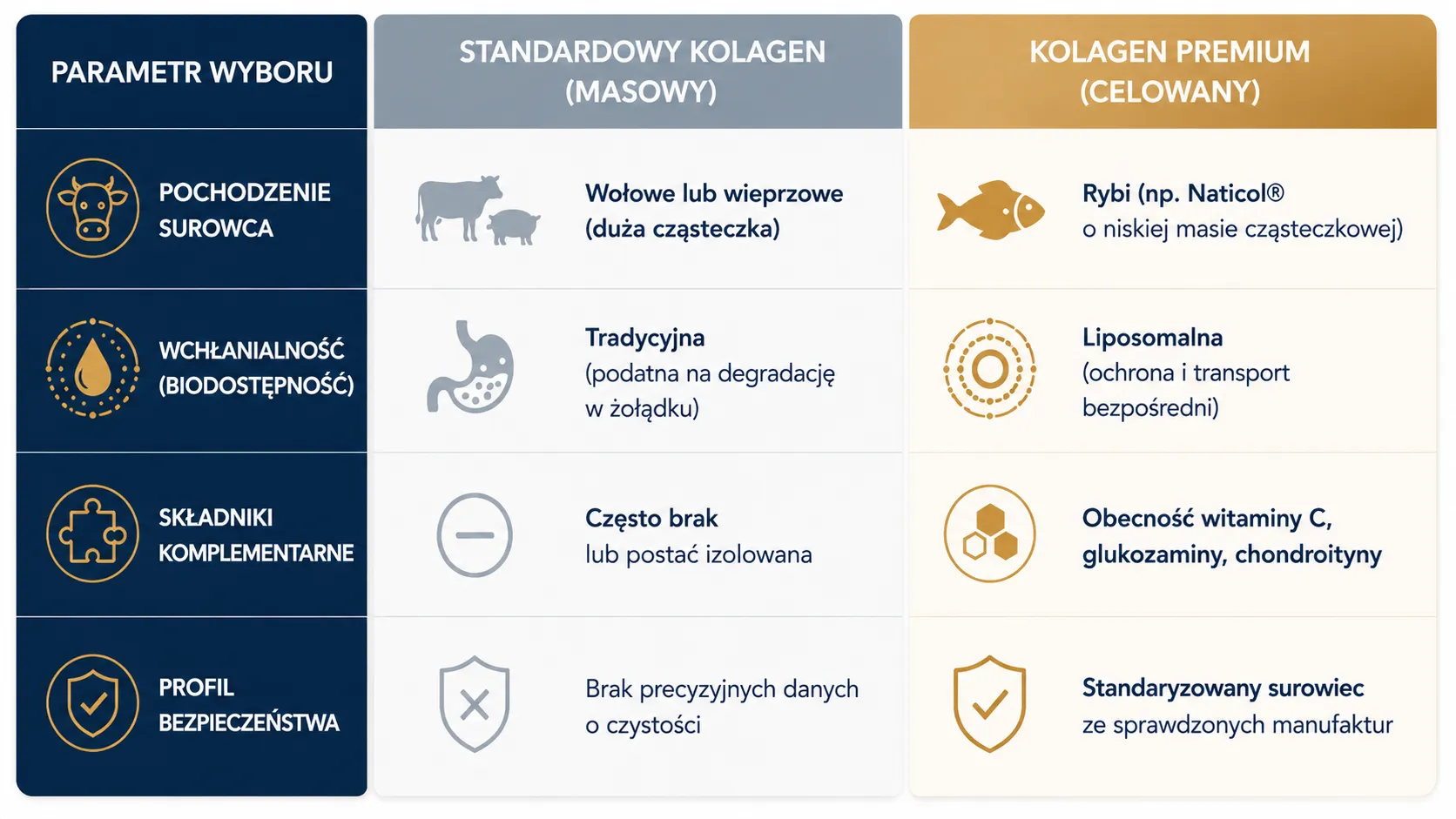
In order to assess honestly and reliably whether supplementation is bringing the expected results, give your body a minimum of 3 months of regular, daily use of the chosen preparation. Remember that the key is continuity – skipping a few doses a week interrupts the process of stable saturation of the tissues. By choosing technologically advanced products, such as the BeautyLip® line for beauty support or FlexLip® for the condition of the locomotor system, you base your routine on the proven Naticol® raw material and on liposomal protection. Approach your body with respect and patience, and the effects in the form of support for skin elasticity or joint comfort will be the best reward for your consistency.
See also
other posts

Liposomal collagen — a revolution in skincare from within
Liposomal collagen – will it be a revolution in skincare...
More about our technology

How to moisturise your skin from within and why is it so important?
A dull, rough complexion with no radiance can effectively lower...
More about our technology

Which collagen to choose? Facts and myths about fish collagen
The market for collagen supplements is growing at a dizzying...
More about our technology