Which collagen to choose? Facts and myths about fish collagen
04 May, 2026

The market for collagen supplements is growing at a dizzying pace – manufacturers outdo one another in promises concerning the rejuvenation of the skin and the regeneration of joints, yet not all the information circulating online deserves your trust. Have you ever wondered which collagen to choose in order to genuinely support the condition of your body instead of overpaying for a product of doubtful effectiveness?
In this article you will find a reliable comparison of fish and bovine collagen, and you will also get to know the facts and myths that may make it harder to take a conscious purchasing decision. Prepare yourself for a dose of knowledge that will let you look at the subject of collagen from a completely new perspective.
Fish or bovine collagen – which form is better? A comparison of the sources and types of collagen
The answer to the question of the superiority of one collagen source over another depends above all on your individual needs and the goals of your supplementation, because both kinds are characterised by different properties and applications. In order to understand all the nuances, it is worth first explaining what collagen is – it is a structural protein constituting the basic building material of the skin, tendons, ligaments and cartilage, whose production in the body naturally falls with age.
Bovine collagen, obtained from the hides and bones of cattle, contains mainly type I and III collagen, whereas fish collagen – coming from the skins of sea fish – is above all a source of type I, characterised by a lower molecular weight. It is precisely this difference in structure that translates into the rate of absorption – studies indicate the advantage of the fish form in terms of bioavailability.
When choosing a supplement, you should take into account both the source of the raw material and the additional ingredients supporting collagen synthesis in the body – the question of which collagen to choose becomes a question that requires an analysis of the composition, not only of marketing slogans.
3 facts about fish collagen worth knowing before buying a supplement
Before you reach for a supplement with fish collagen, you should get to know three key facts that will help you tell a valuable product from an average one.

Fact 1. Fish collagen has the lowest molecular weight of all sources – which is why it is absorbed faster
The molecular weight of collagen directly influences its ability to penetrate the intestinal barrier, and fish collagen stands out in this respect with values considerably lower than bovine or porcine collagen. Smaller molecules pass more easily into the bloodstream, thanks to which they can reach the tissues requiring support – the skin, joints or hair – more effectively.
In addition, liposomal collagen offers even higher bioavailability, because liposomes protect the active ingredients against degradation in the digestive tract. That is precisely why the best-absorbed collagen is often fish collagen in an advanced form of administration, which maximises the body's use of the ingredients.
Here are the key advantages of a low molecular weight of collagen:
- faster absorption in the small intestine translates into more effective delivery to the target tissues;
- better bioavailability means that the body uses a larger percentage of the dose taken;
- smaller molecules do not burden the digestive system and less frequently cause discomfort;
- more effective delivery to the skin may support its hydration and elasticity;
- support for joints and ligaments should be more noticeable with regular use.

Liposomal collagen BeautyLip® for hair, skin and nails
Fact 2. The amino acid profile of fish collagen is the closest to human collagen
Collagen consists of characteristic amino acids – glycine, proline and hydroxyproline – whose proportions differ depending on the source of the protein. The amino acid profile of fish collagen shows the greatest similarity to the collagen occurring naturally in the human body, which may translate into a better use of the supplied amino acids by the cells.
Naticol® fish collagen is an example of a raw material with a carefully researched amino acid composition, obtained from cod skins by renowned European manufacturers. What fish collagen with an optimal amino acid profile gives includes potential support for the regenerative processes of the skin and connective tissues, although individual effects may differ.
Fact 3. Fish collagen obtained from the skins of wild fish is purer than collagen from industrial farming
The quality of the raw material is the foundation of a supplement's effectiveness – in the case of fish collagen too, the source of the fish is of key importance for the purity and safety of the final product. Wild fish, living in their natural environment, are not exposed to antibiotics or to the substances used in industrial farming, and therefore they do not deliver potentially harmful contaminants.
Liposomal technology additionally raises the quality of a supplement by ensuring the protection of the active ingredients and their stability. The best collagen therefore combines a high-quality raw material with an advanced form of administration that guarantees maximum use by the body.
3 myths about fish collagen that may make it harder to choose a good supplement
In the thicket of information about collagen it is easy to come across beliefs that have no confirmation in scientific research. Below we debunk the three most popular myths circulating among consumers.
Myth 1. Fish collagen works only on the skin, and bovine collagen is better for the joints
The belief in the exclusively "cosmetic" action of fish collagen results from a misunderstanding concerning the types of this protein and their functions in the body. Type I collagen, dominant in fish collagen, occurs not only in the skin, but also in the tendons, ligaments and bone tissue – this means that it can support the condition of the musculoskeletal system in a similar way to bovine collagen.
Dietary supplements for joints containing fish collagen often combine it with glucosamine, chondroitin and hyaluronic acid, creating a comprehensive formula for physically active people. When wondering what fish collagen may influence, it is worth taking the following elements into account:
- the dermis, where collagen is responsible for firmness and elasticity;
- the joints, in which it supports the regeneration of articular cartilage;
- the tendons and ligaments, which require collagen in order to maintain their strength;
- bone tissue, for which it is a structural element;
- the gums and teeth, where it performs a supporting function.
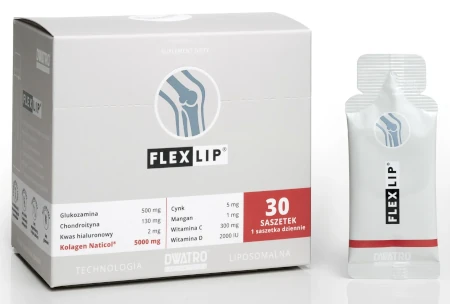
Liposomal fish collagen with glucosamine and chondroitin FlexLip® for joints
Myth 2. Fish collagen has an unpleasant smell and taste
Concerns about the fishy smell and taste of supplements with marine collagen result from experiences with low-quality products or outdated production technologies. Contemporary methods of purification and hydrolysis eliminate the characteristic smell, while advanced forms of administration – such as liposomal gels in sachets – offer a pleasant taste without the need to dissolve powder in liquids.
When considering which fish collagen to choose, you should pay attention to the form of the product, the presence of natural flavourings and the opinions of users concerning its taste qualities. Modern supplements in the form of ready-to-consume sachets completely change the experience of supplementation, making it convenient and pleasant.
Myth 3. All fish collagens are the same – only the dose matters
The assumption that it is enough to check the gram content of collagen on the packaging overlooks a whole range of factors that determine a supplement's actual effectiveness. Besides the amount of collagen, the following are of key importance: the source of the raw material, the method of hydrolysis, the molecular weight of the peptides and the presence of synergistic ingredients.
Vitamin C activates the enzymes indispensable for the production of the body's own collagen, zinc supports regenerative processes, while hyaluronic acid complements the moisturising action. The question of which collagen to choose should therefore revolve around the whole formula of the product, not only around the main ingredient.
While shopping, analyse the following quality criteria:
- the origin of the raw material – whether the collagen comes from wild or farmed fish;
- the molecular weight of the peptides – a lower one means better absorbability;
- the form of administration – liposomal, powder, capsules or liquid;
- additional ingredients – vitamin C, zinc, biotin, hyaluronic acid;
- quality certificates – confirming the safety and purity of the product.
Remember that supplements for skin, hair and nails combining high-quality collagen with synergistic ingredients may offer comprehensive support, yet the final effects depend on the regularity of use and on the individual predispositions of the body.
A conscious choice of a collagen supplement requires looking beyond marketing slogans and reaching for knowledge based on facts – you now have at your disposal the tools that will let you take a well-thought-out decision. Go for a product combining a proven source of raw material, optimal bioavailability and a carefully selected composition of supporting ingredients – and do not let yourself be misled by promises with nothing behind them.

See also
other posts

How to moisturise your skin from within and why is it so important?
A dull, rough complexion with no radiance can effectively lower...
More about our technology

How long should you take collagen to see the effects?
We live in a culture that has accustomed us to...
More about our technology

Liposomal collagen — a revolution in skincare from within
Liposomal collagen – will it be a revolution in skincare...
More about our technology